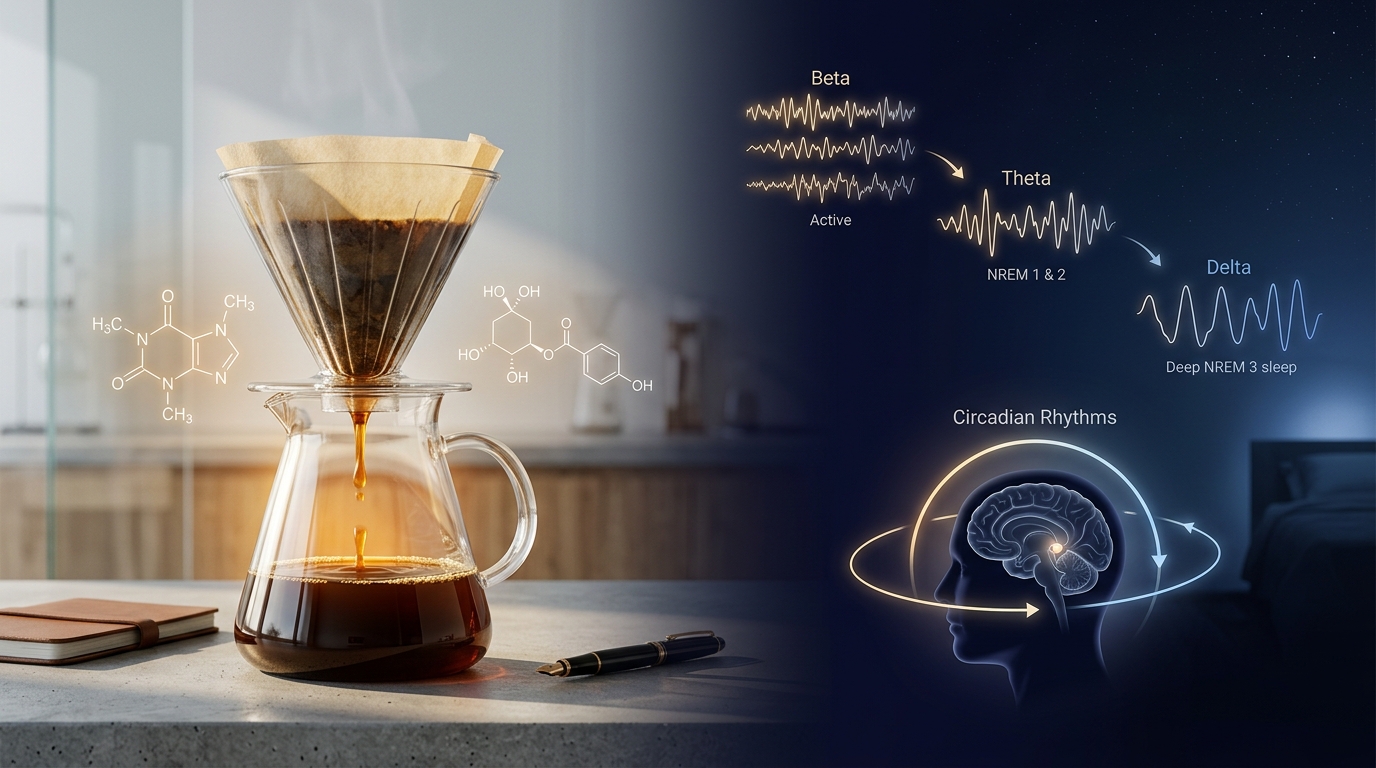
If you have ever made the deliberate decision to cut coffee out of your life—cold turkey, enduring three days of throbbing vascular headaches, lethargy, and brain fog—you almost certainly experienced something extraordinary on the other side:
Deep, unbroken, restorative sleep.
You wake up before your alarm. The grogginess that used to require a chemical intervention to dissolve is gone, replaced by a steady, baseline alertness driven by your body’s natural cortisol awakening response. Your resting heart rate drops by several beats per minute. The low-grade background hum of nervous anxiety evaporates.
And yet, the moment you open your news feed, a wall of headlines screams the exact opposite:
- “Three Cups of Coffee a Day Linked to Longer Lifespan!”
- “Drinking Coffee Cuts Risk of Type 2 Diabetes and Heart Disease by 25%!”
- “Why Coffee Might Be the Ultimate Anti-Aging Superfood, According to Science.”
It creates immediate cognitive dissonance. If coffee is a certified longevity elixir, why did quitting it make your body and mind feel dramatically more coherent? Are you sabotaging your cardiovascular system and life expectancy by choosing sleep over espresso? Or is what we hear on the evening news an elaborate concoction of industry public relations, observational epidemiological traps, and media clickbait?
To find the ground truth, we have to look past the superficial lifestyle journalism and examine the primary literature: the pharmacology of methylxanthines, the molecular genetics of adenosine receptors, the lipid kinetics of diterpenes, and the critical distinction between observational correlation and Mendelian randomization.
Here is what the science actually says about coffee, your body, and your sleep.
1. The Anatomy of a Health Headline: Correlation vs. Marketing
Virtually every viral article touting the magical health benefits of coffee traces back to observational nutritional epidemiology—studies analyzing enormous public health databases like the UK Biobank, the Harvard Nurses’ Health Study, or the European Prospective Investigation into Cancer and Nutrition (EPIC).
Researchers track hundreds of thousands of participants over decades, administer food-frequency questionnaires, and correlate dietary habits with health outcomes. Time and time again, these studies produce a characteristic J-shaped or U-shaped curve: people who drink 2 to 4 cups of coffee per day have lower all-cause mortality, less cardiovascular disease, and lower rates of neurodegenerative conditions than non-drinkers.
Mainstream health journalists summarize this with breathless certainty: Coffee extends your life.
Except observational epidemiology cannot prove causation. When you examine the mechanics of these cohorts, three profound statistical distortions emerge.
┌────────────────────────────────────────────────────────────────────────┐
│                   THE THREE EPIDEMIOLOGICAL DISTORTIONS                │
├─────────────────────────┬──────────────────────────────────────────────┤
│ 1. Healthy User Bias    │ Coffee drinkers in modern cohorts skew       │
│                         │ higher-income, more active, and have         │
│                         │ superior healthcare access.                  │
├─────────────────────────┼──────────────────────────────────────────────┤
│ 2. The "Sick Quitter"   │ People stop drinking coffee when diagnosed   │
│    Effect               │ with arrhythmias, ulcers, GERD, or anxiety,  │
│                         │ making the non-drinker group artificially    │
│                         │ unhealthy.                                   │
├─────────────────────────┼──────────────────────────────────────────────┤
│ 3. Relative vs.         │ A "15% reduction in mortality risk" sounds   │
│    Absolute Risk        │ massive, but often translates to an absolute │
│                         │ risk reduction of fractions of a percent.    │
└─────────────────────────┴──────────────────────────────────────────────┘
The “Sick Quitter” Bias (Reverse Causality)
Who are the people in the “zero coffee” control groups?
While some are lifelong abstainers, a substantial percentage are former coffee drinkers who quit because they fell ill. When a person develops cardiac arrhythmias, severe gastroesophageal reflux disease (GERD), gastric ulcers, chronic insomnia, unmanageable hypertension, or panic disorder, the very first instruction their physician gives them is: stop drinking coffee.
If a study lumps these compromised individuals into the non-drinking cohort, the non-drinking group will naturally experience higher mortality and worse cardiovascular outcomes. The statistical model then credits coffee with “protective” properties that are actually just the absence of pre-existing systemic disease in the drinking cohort.
The Healthy User Effect
In Western urban societies, regular coffee consumption—particularly specialty pour-overs, high-end espresso, and artisan roasts—correlates strongly with socioeconomic status, disposable income, gym memberships, and access to preventive medical care. While researchers attempt to mathematically “adjust” for income, smoking, and BMI, residual confounding is notoriously impossible to eliminate completely.
The Coffee PR Machine
It is also naive to overlook the financial architecture backing coffee research. The Institute for Scientific Information on Coffee (ISIC) is a non-profit organization funded directly by major commercial coffee roasters including Nestlé, illy, Lavazza, Jacobs Douwe Egberts (JDE Peet’s), and Tchibo.
ISIC does not forge data; they don’t have to. Instead, they strategically fund academic grants that explore positive metabolic associations, aggregate favorable studies, and distribute polished, media-friendly press releases directly to news desks worldwide. News editors hungry for viral lifestyle content eagerly publish: “Good news about your favorite morning vice!” because validation of bad habits generates ten times the engagement of cautionary pharmacology.
2. The Mendelian Randomization Reality Check
How do we strip away the confounding, the wealth bias, and the sick quitters?
In modern genetic epidemiology, the gold standard for establishing true causality without running an impossible 30-year randomized double-blind trial is Mendelian Randomization (MR).
MR exploits nature’s randomized clinical trial: at conception, genetic alleles are randomly distributed across the population. Scientists identify specific single nucleotide polymorphisms (SNPs) associated with higher caffeine metabolism and coffee intake (such as variants near the CYP1A2 and AHR genes). Because these genetic variants are randomly assigned at birth, they are completely immune to socioeconomic confounding, lifestyle choices, and reverse causality.
If coffee intake directly causes lower mortality and protects against cardiovascular disease, individuals carrying genetic predispositions for high coffee consumption should exhibit significantly lower rates of heart disease and extended lifespans.
What did Mendelian Randomization studies actually find?
Across large-scale MR investigations published over the last several years:
- All-Cause Mortality: Genetically predicted coffee and caffeine consumption shows no causal protective effect on all-cause mortality. The apparent survival advantage seen in observational studies largely vanishes.
- Cardiovascular Disease & Stroke: MR studies show no causal reduction in coronary artery disease, myocardial infarction, or stroke.
- Type 2 Diabetes: While some MR studies show modest causal effects of higher circulating caffeine on lower body mass index (BMI) and slightly lower type 2 diabetes risk, the dramatic 25–30% risk reductions touted by observational headlines do not hold up as a pure pharmacological benefit of coffee drinking.
The verdict from genetic epidemiology is unequivocal: Coffee is not a magic potion that extends your lifespan. The sweeping longevity claims pushed by lifestyle blogs are overwhelmingly the byproduct of observational correlation and healthy user confounding.
3. Coffee $\neq$ Caffeine: The Decaf Smoking Gun
To understand what coffee actually does to the human body, we must eliminate the common linguistic conflation: coffee is not simply a liquid vehicle for caffeine.
A brewed cup of coffee is a complex botanical broth containing more than 1,000 distinct bioactive compounds:
- Chlorogenic Acids (CGAs): Powerful polyphenols (including 5-caffeoylquinic acid and ferulic acid) that exhibit strong antioxidant activity, improve endothelial nitric oxide synthase (eNOS) signaling, reduce vascular inflammation, and enhance peripheral insulin sensitivity via GLUT4 translocation.
- Trigonelline: An alkaloid with neuroprotective and anti-diabetic properties that degrades during roasting into nicotinic acid (Vitamin B3 / Niacin).
- Melanoidins: Complex nitrogenous polymers formed during the Maillard roasting process that act as soluble prebiotics, feeding beneficial Bifidobacterium species in the gut microbiome.
- Magnesium & Potassium: Essential intracellular minerals that support vascular tone and glycemic control.
       ┌────────────────────────────────────────────────────────┐
       │                 WHAT'S IN A CUP OF COFFEE?             │
       ├───────────────────────────┬────────────────────────────┤
       │ Polyphenols & CGAs        │ Antioxidant, anti-inflam-  │
       │ (~200–350 mg)             │ matory, insulin sensitizer │
       ├───────────────────────────┼────────────────────────────┤
       │ Trigonelline & Niacin     │ Neuroprotective, metabolic │
       │ (~20–40 mg)               │ cofactor                   │
       ├───────────────────────────┼────────────────────────────┤
       │ Caffeine                  │ Central nervous system     │
       │ (~80–180 mg)              │ stimulant, adenosine block │
       ├───────────────────────────┼────────────────────────────┤
       │ Diterpenes (Cafestol)     │ Potent LDL-raising lipids  │
       │ (Unfiltered only)         │ (trapped by paper filters) │
       └───────────────────────────┴────────────────────────────┘
Now, consider the single most revealing fact in nutritional science regarding coffee:
In virtually every massive prospective cohort—including the Nurses’ Health Study, the Health Professionals Follow-Up Study, and the UK Biobank—decaffeinated coffee confers almost the exact same reductions in Type 2 Diabetes risk, non-alcoholic fatty liver disease (NAFLD), and liver cirrhosis as regular caffeinated coffee.
Let that sink in.
The metabolic, hepatic, and anti-inflammatory benefits attributed to coffee are driven primarily by the polyphenols and chlorogenic acids, not by caffeine. In fact, isolated caffeine acutely impairs glucose tolerance by stimulating epinephrine secretion and transiently inducing peripheral insulin resistance.
You do not need caffeine to obtain the biological benefits of the coffee bean. The active health agent is the plant antioxidant matrix.
The Brewing Trap: Cafestol and Your Lipids
There is another critical biochemical nuance that news articles consistently omit: how you brew your coffee matters profoundly for your cardiovascular system.
Coffee beans contain fat-soluble diterpenes known as cafestol and kahweol. Cafestol is one of the most potent cholesterol-elevating compounds in the human diet. It functions as an agonist for nuclear receptors (such as the farnesoid X receptor / FXR and pregnane X receptor / PXR) in the liver, downregulating the expression of CYP7A1 (the rate-limiting enzyme in bile acid synthesis) and suppressing hepatic LDL receptors.
The result? Circulating LDL cholesterol (LDL-C) and Apolipoprotein B (ApoB) rise significantly.
BREWING METHOD                 CAFESTOL PER CUP        LDL-C IMPACT
────────────────────────────────────────────────────────────────────────
French Press / Cafetière       6–8 mg                  Significant Increase
Scandinavian Boiled / Turkish  8–12 mg                 Substantial Increase
Espresso / Moka Pot            1–2 mg                  Moderate (Cumulative)
Standard Paper Filter Drip     < 0.1 mg                Zero / Negligible
Chemex / V60 / Kalita Wave     < 0.1 mg                Zero / Negligible
If you drink unfiltered coffee (French press, Scandinavian boiled coffee, Turkish coffee, or excessive espresso), you are actively elevating your circulating atherogenic lipoproteins. Only paper filters contain the specific microscopic pore structure and lipophilic fibers required to trap cafestol and kahweol oils while allowing the water-soluble chlorogenic acids to pass through.
4. The Neuroscience of Sleep: Why You Were Right to Quit
If the longevity claims are heavily inflated and the metabolic benefits belong to polyphenols rather than caffeine, what does caffeine itself actually do to the human body?
It systematically impairs your sleep architecture.
The Adenosine Dam
To understand caffeine’s mechanism, you must understand Process S—the homeostatic sleep drive.
From the second you wake up, your brain’s neurons are continuously burning adenosine triphosphate (ATP) for energy. The byproduct of this cellular metabolism is adenosine. Throughout the day, adenosine molecules accumulate in the extracellular space of your brain, binding to $A_1$ and $A_{2A}$ adenosine receptors located on neurons in the basal forebrain and the ventrolateral preoptic nucleus (VLPO).
As more adenosine binds, neuronal firing slows down. Your eyelids grow heavy. Sleep pressure mounts. This is your brain’s biological fuel gauge signaling that it needs downtime to repair, restore glycogen reserves, and clear metabolic waste.
NATURAL WAKEFULNESS:
  ATP Burning ──> Adenosine Accumulates ──> Binds to A1/A2A Receptors ──> Deep Sleep Drive (Process S)

WITH CAFFEINE:
  Caffeine ──> Crosses Blood-Brain Barrier ──> Plugs A1/A2A Receptors (Antagonist)
                                               │
                                               ▼
  Adenosine continues building up behind the dam, undetected by the brain.
  When caffeine clears ──> Massive Adenosine Flood ──> The Afternoon Crash.
Caffeine is an almost perfect molecular mimic of adenosine. It crosses the blood-brain barrier and slots into the $A_1$ and $A_{2A}$ receptors with high affinity. However, caffeine is an antagonist: it occupies the receptor without activating it. It acts like a key inserted into a deadbolt that fits, but doesn’t turn—blocking the real key from entering.
Caffeine does not create energy. It creates chemical blindness. Your brain is just as exhausted as it was five minutes earlier, but it can no longer perceive its own metabolic debt.
Meanwhile, adenosine does not stop producing. It continues piling up outside the blocked receptors like floodwater behind a dam. When your liver finally metabolizes the caffeine, that accumulated ocean of adenosine rushes in all at once, violently binding to the newly vacant receptors. This is the biological mechanism of the dreaded afternoon crash.
The Quarter-Life Fallacy
Most people drastically underestimate caffeine’s persistence in the human body.
In healthy adults, the average elimination half-life of caffeine is approximately 5 to 7 hours. But half-life only measures when 50% of the drug has cleared. In pharmacology, the more clinically relevant metric is the quarter-life (the time it takes for 75% of the compound to be cleared, leaving 25% active in the body).
Caffeine’s quarter-life is approximately 10 to 14 hours.
A 200 mg Caffeine Timeline (e.g., a 16 oz coffee or double espresso at 2:00 PM):

  02:00 PM:  200 mg ingested (Peak plasma concentration at ~2:45 PM)
  07:30 PM:  100 mg active in your brain (Equivalent to a strong cup of black tea)
  01:00 AM:   50 mg active in your brain (Equivalent to a can of Coca-Cola)
  06:30 AM:   25 mg still circulating as your alarm rings
When you go to bed at 11:30 PM after a 2:00 PM coffee, you are not sleeping with a clean nervous system. You are going to bed with approximately a quarter to a third of a cup of coffee actively circulating through your brainstem.
The “Restorative Illusion” & Quantitative EEG
The most dangerous trap in caffeine consumption is what sleep scientists call the “Restorative Illusion.”
Millions of people declare: “I can drink a double espresso at 9:00 PM and fall asleep immediately. Caffeine doesn’t affect me!”
Subjective perception of sleep onset latency has almost zero correlation with objective sleep architecture. Polysomnography (PSG) and quantitative electroencephalogram (qEEG) studies paint a devastating picture:
- Slow-Wave Sleep (SWS / Stage N3) Suppression: Meta-analyses of PSG trials (including comprehensive reviews in 2023 and 2025) demonstrate that caffeine systematically reduces deep slow-wave sleep. Even when participants slept for 8 hours, their high-amplitude, low-frequency delta waves (0.5–4 Hz) were blunted.
- Total Sleep Time Reduction: On average, caffeine intake decreases objective total sleep time by 35 to 45 minutes per night.
- Micro-Arousals & Sleep Fragmentation: Caffeine increases stage N1 (very light, transition sleep) and elevates Wake After Sleep Onset (WASO) by an average of 12 minutes, causing micro-awakenings that the sleeper never consciously remembers.
┌────────────────────────────────────────────────────────────────────────┐
│             WHAT CAFFEINE DOES TO YOUR SLEEP ARCHITECTURE              │
│                 (Meta-Analysis of Polysomnography Data)                │
├───────────────────────────────────┬────────────────────────────────────┤
│ Total Sleep Time (TST)            │ Reduced by 35–45 minutes           │
├───────────────────────────────────┼────────────────────────────────────┤
│ Deep Sleep (Slow-Wave Sleep / N3) │ Reduced by 11.4 minutes (blunted)  │
├───────────────────────────────────┼────────────────────────────────────┤
│ Sleep Onset Latency (SOL)         │ Increased by 8–10 minutes          │
├───────────────────────────────────┼────────────────────────────────────┤
│ Wake After Sleep Onset (WASO)     │ Increased by ~12 minutes           │
├───────────────────────────────────┼────────────────────────────────────┤
│ Delta Power (Slow-Wave Activity)  │ Suppressed across early cycles     │
└───────────────────────────────────┴────────────────────────────────────┘
Why does the loss of slow-wave sleep matter so profoundly?
Because Stage N3 deep sleep is when the brain’s glymphatic system opens.
During slow-wave sleep, glial cells shrink by up to 60%, allowing cerebrospinal fluid (CSF) to wash through the interstitial space of the brain like a biological dishwasher, clearing out metabolic debris—most notably amyloid-beta and phosphorylated tau proteins, the hallmark aggregates of Alzheimer’s disease. Slow-wave sleep is also the precise window when the pituitary gland releases its primary nocturnal pulse of human growth hormone (HGH) for tissue repair, cellular regeneration, and immune modulation.
When caffeine deprives you of slow-wave sleep, you wake up biologically un-repaired, regardless of whether you spent 8 hours in bed.
5. Pharmacogenomics: Why “One-Size-Fits-All” Is Dangerous
There is a biological reason why your colleague can drink four coffees a day without an issue, while a single cup gives you palpitations, cold sweats, and insomnia.
Your response to coffee is hardcoded in your DNA by two specific enzymes:
GENE           POLYMORPHISM        FUNCTION
─────────────────────────────────────────────────────────────────────────
CYP1A2         rs762551            Rate of caffeine breakdown in liver
ADORA2A        rs5751876           Adenosine receptor sensitivity in brain
1. CYP1A2: The Liver’s Clearance Engine
Approximately 95% of caffeine metabolism in the liver is executed by the cytochrome P450 enzyme CYP1A2. A common single nucleotide polymorphism (rs762551) dictates how rapidly this enzyme functions:
- AA Genotype (“Fast Metabolizers”): Roughly 40–45% of the population. These individuals synthesize high concentrations of the active enzyme. Caffeine half-life can be as short as 2 to 4 hours.
- AC or CC Genotype (“Slow Metabolizers”): Roughly 55% of the population. These individuals carry the $*1F$ allele, resulting in sluggish enzymatic clearance. In slow metabolizers, caffeine’s half-life can stretch to 8 to 12 hours or more.
In a landmark study published in JAMA by Dr. Marilyn Cornelis and Dr. Ahmed El-Sohemy, researchers evaluated coffee consumption and non-fatal myocardial infarction across thousands of patients stratified by CYP1A2 genotype:
- For fast metabolizers, drinking 1 to 3 cups of coffee per day was neutral or slightly protective against heart attacks.
- For slow metabolizers, drinking 2 to 3 cups per day was associated with a 36% increased risk of myocardial infarction, and 4+ cups per day was associated with a 64% increased risk.
Because slow metabolizers retain caffeine in their systemic circulation for up to 16 hours, the prolonged vasoconstriction, elevated sympathetic tone, and blood pressure spikes create genuine cardiovascular wear and tear.
2. ADORA2A: The Sensitivity Switchboard
Even if your liver clears caffeine at an average speed, the ADORA2A gene encodes the structure of your adenosine $A_{2A}$ receptors in the brain.
Variations at the rs5751876 locus determine your receptor’s binding affinity. Individuals carrying the sensitive genotype experience pronounced central nervous system excitation: acute anxiety, jitteriness, panic sensations, and severe sleep disruption even at modest doses (50–100 mg).
When public health headlines announce that “everyone should drink coffee for their health,” they are ignoring basic human pharmacogenomics. For half of the population, chronic caffeine consumption is a direct metabolic stressor.
6. Going Cold Turkey: The Physiological Reset
If you recently quit coffee cold turkey, what actually occurred inside your physiology?
CHRONIC CONSUMPTION:
  Brain senses blocked adenosine ──> Compensates by creating MORE receptors (Upregulation)
                                     │
                                     ▼
COLD TURKEY CESSATION:
  Day 1–3: Massive adenosine flood onto supersized receptor field
           ──> Severe cerebral vasodilation (Vascular migraine/headache)
           ──> Acute lethargy, brain fog, dysphoria
                                     │
                                     ▼
DAY 5–14 (NEUROCHEMICAL ADAPTATION):
  Brain prunes excess receptors back to normal baseline density (Downregulation)
  Adenosine tone re-calibrates
                                     │
                                     ▼
LONG-TERM OUTCOME:
  Restoration of natural delta Slow-Wave Sleep (N3)
  Rebound REM sleep with vivid dreaming
  Cortisol awakening response (CAR) restored: natural morning wakefulness
  Resting heart rate drops, baseline autonomic nervous system balances
During chronic caffeine intake, your brain isn’t passive. Sighting that its adenosine receptors are continually obstructed, it executes homeostatic compensation: it upregulates, synthesizing hundreds of new adenosine receptors to maintain its ability to sense fatigue.
When you suddenly pull the plug on caffeine, you don’t just return to normal; you plunge into a state of acute adenosine hypersensitivity.
Because caffeine causes mild cerebral vasoconstriction, its sudden absence triggers rebound cerebral vasodilation—the blood vessels in your brain widen abruptly, creating the agonizing vascular migraine that defines caffeine withdrawal. Simultaneously, normal ambient levels of adenosine latch onto an abnormally high density of receptors, inducing profound fatigue.
It takes 7 to 14 days for your brain to downregulate those excess receptors and re-establish baseline neurochemical homeostasis.
Once that receptor remodeling completes, the biological payoff is immense:
- Sleep depth is restored: Your delta waves can oscillate at their natural high-amplitude frequency, allowing deep stage N3 sleep to repair brain tissue and muscle glycogen.
- REM Rebound: You experience a flood of vivid, narrative dreams as your brain catches up on compressed rapid-eye-movement cycles.
- Endogenous Morning Wakefulness: Your morning wake-up signal is once again orchestrated by the Cortisol Awakening Response (CAR) and circadian core body temperature elevation, rather than an exogenous pharmacological jolt that artificially masks exhaustion.
7. The Scorecard: Truth vs. Marketing Hype
To cut through the noise, let’s look at the scientific consensus across every major health domain:
┌────────────────────────┬───────────────────────────────────────────────┐
│ HEALTH DOMAIN          │ SCIENTIFIC REALITY VS. MEDIA HEADLINE         │
├────────────────────────┼──────────────────────────────────────────────┤
│ 1. All-Cause Mortality │ HEADLINE: "Coffee adds years to your life."   │
│                        │ REALITY: Disproved by Mendelian Randomization │
│                        │ studies. Driven by healthy user bias and the  │
│                        │ "sick quitter" effect in observational data.  │
├────────────────────────┼──────────────────────────────────────────────┤
│ 2. Type 2 Diabetes     │ HEADLINE: "Caffeine prevents diabetes."       │
│                        │ REALITY: Real effect, but driven by           │
│                        │ chlorogenic acids and polyphenols, NOT        │
│                        │ caffeine. Decaf works equally well.           │
├────────────────────────┼──────────────────────────────────────────────┤
│ 3. Liver Health        │ HEADLINE: "Coffee shields liver from disease."│
│                        │ REALITY: Genuine hepatoprotective benefit.    │
│                        │ Present in both regular and decaf coffee.     │
├────────────────────────┼──────────────────────────────────────────────┤
│ 4. Cardiovascular      │ HEADLINE: "Coffee strengthens your heart."    │
│    Health              │ REALITY: Highly genotype-dependent (CYP1A2). │
│                        │ Unfiltered coffee (cafestol) raises LDL-C.    │
│                        │ Harmful for slow metabolizers.                │
├────────────────────────┼──────────────────────────────────────────────┤
│ 5. Sleep Architecture  │ HEADLINE: "One morning cup doesn't hurt."    │
│                        │ REALITY: 10–14 hr quarter-life blunts N3 deep │
│                        │ slow-wave sleep and suppresses delta waves,   │
│                        │ even when you fall asleep easily.             │
└────────────────────────┴──────────────────────────────────────────────┘
8. The Strategic Protocol: How to Navigate Coffee Moving Forward
Having walked away cold turkey, you have given yourself the greatest diagnostic gift possible: a clean biological baseline. You now know what unmedicated, deep sleep feels like.
If you are wondering how to reconcile this with coffee’s real, non-fabricated benefits, here is the evidence-based protocol:
Option A: The Decaf Route (Best of Both Worlds)
If you enjoy the taste, ritual, and genuine polyphenol benefits of coffee (lower diabetes risk, liver protection, gut microbiome support), switch to Swiss Water Process Decaf brewed through a paper filter.
- The Swiss Water process removes 99.9% of caffeine using osmosis and carbon filtration without chemical solvents like methylene chloride.
- You preserve nearly 100% of the chlorogenic acids, trigonelline, and melanoidins.
- You completely bypass the adenosine receptor disruption, preserving your restorative slow-wave sleep.
Option B: Obtaining Polyphenols Elsewhere
Remember that coffee is not unique. It simply happens to be the single largest source of dietary antioxidants in Western nations because the average Western diet is otherwise completely devoid of whole plant foods.
If you eat a diverse diet rich in whole foods, you can easily exceed coffee’s antioxidant density without a drop of caffeine:
- Blueberries, blackberries, and pomegranate (anthocyanins and ellagic acid)
- Extra virgin olive oil (oleocanthal and hydroxytyrosol)
- High-grade organic green tea or rooibos (EGCG and aspalathin—green tea has roughly one-third the caffeine of coffee, or zero in rooibos)
- 85%+ dark cacao (flavanols)
- Dark leafy cruciferous vegetables (sulforaphane precursors)
Option C: If You Ever Reintroduce Caffeine
If you decide to reintroduce caffeine for situational cognitive performance or athletic output, adhere strictly to these physiological boundaries:
- The 12-to-14 Hour Hard Curfew: If your target bedtime is 10:30 PM, your absolute last sip of caffeine must be finished by 8:30 AM or 10:30 AM at the very latest. Never consume caffeine in the afternoon.
- Cap the Dose at $\le 100\text{–}150\text{ mg}$: Avoid 20 oz cold brews and quad-shot lattes that deliver 300–400 mg in a single sitting.
- Paper Filter Only: Always brew using Chemex, V60, Kalita, or standard drip paper filters to trap cafestol and protect your LDL-C and ApoB levels.
- Delay 90 Minutes Upon Waking: Wait 60 to 90 minutes after waking before your first cup. This allows your natural morning cortisol pulse to peak and clear residual overnight adenosine, preventing the late-morning energy crater.
The Final Verdict
Your intuition to quit cold turkey was not flawed; it was biologically spot-on.
The media narrative portraying coffee as an unblemished longevity superfood is largely a blend of observational epidemiological artifacts, industry-funded PR, and clickbait journalism designed to make consumers feel virtuous about their daily stimulant habit. While the coffee bean does contain powerful polyphenols that protect the liver and improve glucose metabolism, those benefits belong to the plant matrix—and can be harvested entirely through decaf or a polyphenol-rich diet.
Caffeine itself remains a potent central nervous system stimulant with a 12-hour biological footprint that systematically degrades the depth of your slow-wave sleep.
In the ultimate hierarchy of human longevity, high-quality, restorative slow-wave sleep is non-negotiable. If quitting coffee gave you back your sleep, you have already captured a far greater health dividend than any cup of coffee could ever deliver.